Emfit Ltd

At EMFIT, we focus on enhancing athletic recovery through advanced monitoring. This blog features real feedback from athletes who use EMFIT QS® to improve their performance and recovery.


Emfit QS is the most used sleep-time HRV and recovery monitor by the Finnish national triathlon team.

Insights from a few team members

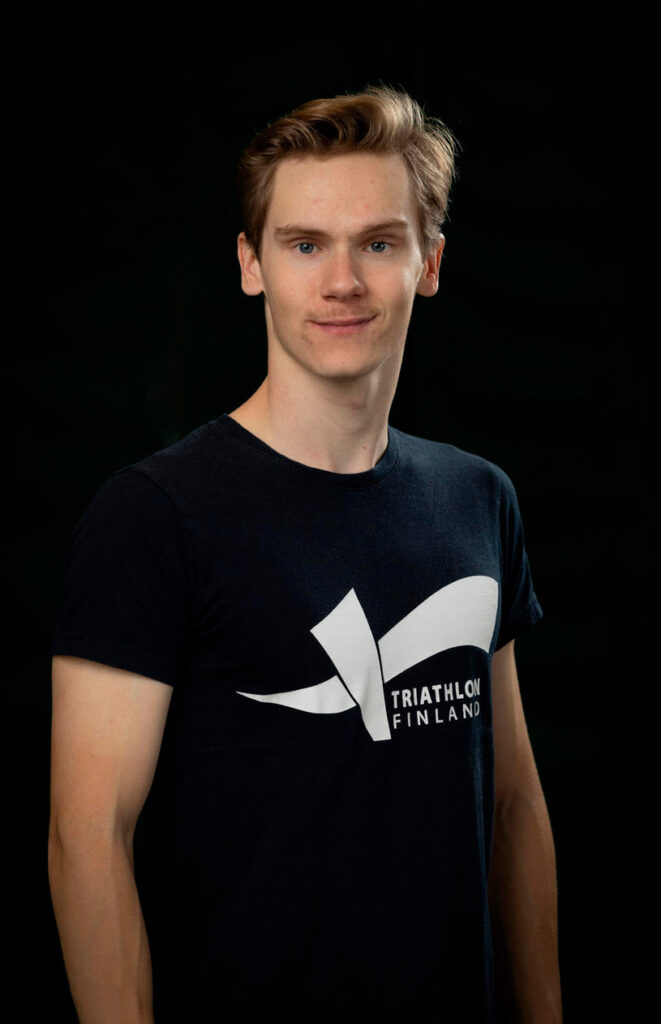
Veikka’s Experience: “EMFIT QS® allows precise and effortless recovery tracking, aiding in training planning, especially post-camp recovery and maintaining peak performance during competition season.”
veikka - emfit qs athletic recovery

Kuva: Juha Hämäläinen


Ville-Valtteri’s Insights: “Data from EMFIT QS® is crucial for my training. Monitoring night-time heart rate and HRV helps me gauge readiness during intense training periods, maximizing benefits from rest. Long-term HRV monitoring reveals overall training load impact, aiding in predicting performance peaks for competitions. The data also helps manage non-sport stress, facilitating better training cycles. Following HRV and average night heart rate is a straightforward method to monitor sleep quality and long-term stress levels. Notably, EMFIT QS® has alerted me to impending colds, allowing preemptive actions to shorten illness or avoid it entirely by adjusting training.”

ville-valtteri salonen emfit qs athletic recovery

Kuva: Roosa Ijäs


Boost Your Athletic Recovery

Integrating EMFIT QS® into your routine provides vital insights into athletic recovery, ensuring you can adjust training to match your body’s needs and enhance overall performance. The data collected helps in personalizing recovery strategies, making it a critical tool for athletes aiming for peak performance.

Enhanced Features for Optimal Recovery

Comprehensive Data Analysis:
EMFIT QS offers detailed reports on sleep quality, duration, and HRV, giving athletes a clear picture of their recovery needs.

User-Friendly Interface:
The intuitive design of the EMFIT QS® dashboard makes it easy to interpret data, helping athletes make informed decisions about their training and recovery plans.

Long-Term Monitoring:
By tracking data over extended periods, athletes can identify patterns and trends, allowing for better adjustment of training schedules to avoid overtraining and enhance performance.

Community and Support:
Joining the EMFIT community gives access to a wealth of shared experiences and tips, further aiding in the journey towards optimal athletic recovery.


Conclusion: Advancing Athletic Recovery

Integrating EMFIT’s contactless monitoring technology into athletic training regimens holds significant promise for enhancing athletic recovery and performance. By offering a non-intrusive, accurate method of sleep and HRV analysis, EMFIT technology provides valuable insights that can optimize training intensity and recovery strategies. For more detailed findings and the importance of ongoing research in this area, see the referenced study. Continued adoption of such innovative technologies is crucial for advancing athletic training practices and improving performance outcomes.

Visit also:

Sleep-Wake Analysis in Elderly Care

At EMFIT, we are dedicated to enhancing the management and care of individuals with cognitive impairments. This article references research utilizing our EMFIT QS product, now rebranded as EMFIT Care for caregiving settings due to its tailored form factor. The study, published in the Journal of Applied Research in Intellectual Disabilities, compares our innovative contactless monitoring technology with traditional actigraphy, offering insights into optimizing sleep-wake pattern monitoring for those with cognitive challenges. Explore the detailed findings of the study.

Background and Research Insights on Sleep Monitoring for Cognitive Impairments

At EMFIT, we continually seek to enhance the management and care of individuals with cognitive impairments. This article draws on recent research published in the Journal of Applied Research in Intellectual Disabilities, where EMFIT’s innovative contactless monitoring technology, EMFIT QS, was compared with traditional actigraphy. This research provides valuable insights into optimizing sleep-wake pattern monitoring for those with cognitive challenges. Explore the detailed findings of the study here.


Enhancing Care with Contactless Sleep Technology for Cognitive Impairments

Navigating through life with cognitive impairments involves numerous challenges, particularly in managing daily routines. Monitoring sleep-wake patterns plays a crucial role in enhancing the quality of life for these individuals. This article explores how EMFIT’s innovative contactless monitoring technology can be pivotal in this regard. Consistent and accurate monitoring helps caregivers and healthcare professionals tailor interventions more effectively, ensuring that individuals receive the best possible care adapted to their unique circadian rhythms. For an in-depth analysis, see the original study on sleep-wake monitoring technologies.


Traditional Monitoring Challenges for Individuals with Cognitive Impairments

Traditionally, wrist actigraphy has been the standard for tracking sleep, but its applicability can be limited for those with cognitive impairments who might find wearables uncomfortable or impractical. This necessitates a look towards more accommodating solutions. People with cognitive impairments often have sensitivity issues that can make wearing devices all night particularly challenging, which can interfere with the accuracy of sleep data collected. Additionally, the invasiveness and discomfort associated with wearables can lead to resistance from the user, complicating long-term monitoring essential for meaningful insights. Embracing non-invasive technologies offers a promising alternative, providing comfort without sacrificing data fidelity.


Advantages of EMFIT’s Contactless Monitoring for Cognitive Health

EMFIT QS provides a seamless and non-invasive alternative, leveraging advanced sensor technology to monitor sleep without direct contact. This method is particularly beneficial for individuals sensitive to physical wearables, offering disturbance-free sleep analysis. The contactless nature of EMFIT QS not only ensures comfort but also enhances the accuracy of sleep data by eliminating the variables introduced by the discomfort of wearable devices. Its unobtrusive approach allows for continuous, real-time monitoring, crucial for adjusting care strategies and improving the long-term well-being of those with cognitive impairments.


Case Study: EMFIT QS versus Traditional Actigraphy in Cognitive Care

Recent studies comparing EMFIT QS with traditional actigraphy have showcased EMFIT’s ability to effectively monitor sleep-wake patterns, despite certain challenges that underscore the need for ongoing research. These findings suggest that while EMFIT QS generally correlates well with established methods in tracking basic sleep metrics, there are noticeable discrepancies in sleep stage differentiation which may affect its utility for certain clinical applications. This highlights the importance of further studies to refine the technology and improve its accuracy in complex scenarios. For a detailed examination of these findings, refer to the original study conducted on individuals with intellectual disabilities as discussed in the source.


Leveraging Technology to Improve Care for Cognitive Impairments

The data collected by EMFIT QS has profound implications for caregiving and healthcare provision, particularly for individuals with cognitive impairments. By accurately monitoring sleep patterns, caregivers can develop more personalized care strategies that address specific sleep-related issues, thereby enhancing the management of conditions commonly associated with cognitive impairments. This targeted approach can lead to significant improvements in daily functioning and overall health outcomes for these individuals.

Leveraging Technology to Improve Care for Cognitive Impairments


Conclusion: Advancing Sleep Monitoring Technology for Cognitive Health

Integrating EMFIT’s contactless monitoring technology into the care regimen for individuals with cognitive impairments holds significant promise for improving their quality of life. By offering a non-intrusive, accurate method of sleep analysis, EMFIT technology provides valuable insights that can enhance sleep quality and overall well-being. For more detailed findings and the importance of ongoing research in this area, see the referenced study. Continued adoption of such innovative technologies is crucial for advancing care practices and improving outcomes in this sensitive field.

Veikka Sarén on monipuolinen urheilija, jolle triathlon valikoitui päälajiksi jo 15-vuotiaana. Kaikenlainen liikunta onkin Veikalle lähellä sydäntä ja hän on harrastanut monipuolisesti liikuntaa mm. hiihtoa, juoksua, pyöräilyä, uintia sekä jääkiekkoa, jalkapalloa ja salibandya. Emfit QS on antanut Veikalle dataa, jolla hän voi seurata omaa palautumistaan ja erityisesti trendejä pitkällä aikavälillä. 

Palautumisen seuranta ja sykevälivaihtelu

Emfit QS:n antamasta datasta eniten seuraan yön sykevälivaihtelua sekä sen vaihtelua illan ja aamun välillä, yön keskisykettä ja autonomisen hermoston tasapainoa. Yön sykevälivaihtelu kertoo erinomaisesti kropan palautuneisuuden tilasta etenkin pidemmällä aikavälillä, jossa pidempään laskussa olevat sykevälivaihtelun arvot heijastuvat selkeästi alipalautuneeseen tunteeseen niin arjessa kuin harjoituksissakin. Vaihtelut sykevälivaihtelussa illan ja aamun välillä taas kertovat unenaikaisesta palautumisesta. Yön sykkeiden avulla sykevälivaihteluiden antamaa dataa taas pystyy analysoimaan vielä tarkemmin, jonka lisäksi matalammat yönaikaiset sykkeet usein liittyvät levollisempaan uneen ainakin itsellä. Autonomisen hermoston tasapaino on sykevälivaihtelun ohella mittari, jolla pitempiaikainen kehon stressitila on helpompi huomata.

Data treenin tukena

Koska harjoittelua lajissani kertyy jo viikkotasolla paljon ja päiväkohtainen vaihtelu suorituskyvyssä on välillä suurtakin, olen pitänyt Emfitin arvokkaimpana datana jo mainitsemaani yönaikaista sykevälivaihtelua ja sen trendiä pidemmällä aikavälillä. Väsymyksen tunteeseen on helppo tottua, joten välillä voi olla vaikeaa huomata (tai myöntää), että kropassa on painanut väsymys jo jonkin aikaa. Silloin kuormituksen ja palautumisen suhdetta on vielä ajoissa mahdollista korjata, ja siten välttää mahdollisesti sairastumiset, loukkaantumiset tai alipalautumistilat. Vaikka en ole toistaiseksi ainakaan dramaattisesti muuttanut harjoittelua Emfitin antaman datan perusteella, on se ollut oiva apu vahvistamaan oman olotilan tunteita, jolloin harjoituspäiviä on voitu keventää tilanteessa, jossa Emfitin arvot ovat olleet samansuuntaisia oman fiiliksen kanssa. Tämä on erityisen tärkeää seuratessa pidempien periodien aikaista rasitusta, esimerkiksi leireillä ja niiden jälkeen, tai kovemmalla kilpailuun valmistavalla kaudella.

Kenelle suosittelen

Suosittelen vahvasti Emfit QS:n käyttöä jokaiselle, joka haluaa kiinnittää vaivattomasti parempaa huomiota omaan palautumiseen ja kuormittumiseen riippumatta oman harrastamisen tavoitteellisuudesta. Emfit QS on myös oiva väline urheilua harrastamattomalle.

CrossFit - Nelli Nurmi

Nelli Nurmi aloitti crossfit lajin parissa vuonna 2015 ja on kilpaillut vuodesta 2016 alkaen. Viimeiset kaksi vuotta hän on kilpaillut kansainvälisellä tasolla ja nykyään hän tähyilee jo Euroopan huippulle. Crossfit vaatii urheilijalta erityisesti kestävyyttä ja voimaa. Lajin treenaaminen on hyvin monipuolista.

  • Nelli on hallitseva Suomen mestari Toiminnallisessa Urheilussa (Functional Fitness) ja MM 7. (International Functional Fitness World Championships)
  • Nelli on hallitseva Painonnoston SM-hopeamitalisti
  • CrossFitin parissa parhaimpina saavutuksina on Euroopan 39. sija vuoden 2021 CrossFit Games neljännesvälierissä sekä 26. sija CrossFit Games Euroopan Semifinaalissa.
  • Työkseen Nelli valmentaa crossfitiä ja painonnostoa, sekä omistaa pienen osan kahdesta saman alan yrityksestä. Niissä hän hoitaaa erinäisiä hallinnollisia ja viestinnällisiä tehtäviä.

Unen laatu ja palautuminen

Minun mielestä urheilijalle on ylipäätään tärkeätä pystyä seuraamaan unen laatua ja varmistua siitä, että keho palautuu unen aikana. Vaikka oman kropan tuntemukset onkin erittäin tärkeää tunnistaa ja kuunnella, on välillä helpompi uskoa tuntemuksia kun katsoo kertynyttä dataa. Jos esimerkiksi huomaan, että edeltävien öiden data vastaa omia tuntemuksiani alipalautumisesta, on minun aiempaa helpompi tehdä päätös esimerkiksi muutaman kevyemmän treenipäivän pitämisestä.

Sykevälivaihtelu unen aikana

Emfit QS auttaa minua seuraamaan sykevälivaihtelua sekä ylipäätään yönaikaista sykettä. Myös ilta-aamu HRV arvoa olen alkanut oppia tulkitsemaan. Siitä pystyy hyvin päättelemään palautumisen tilaa ja esimerkiksi kovempien teho harjoitusten vaikutusta elimistöön.

Crossfit & Nelli nurmi - Emfit QS


Crossfit urheilijan unirutiinit

Crossfit -harjoitteluni on pysynyt suurin piirtein samanlaisena, mutta ilta- ja unirutiineihin olen kiinnittänyt enemmän huomiota. Tämän huomaa myös positiivisesti kertyneessä datassa sekä unen laadussa ja sitä myötä myös palautumisessa. Data näyttelee tärkeää roolia siinä, että näitä rutiineja muistaa ja jaksaa ylläpitää ja se antaa välittömän palautteen, jos niistä rupeaa lepsuilemaan.

Uni ja palautuminen (HRV) työkaluna

Suosittelen Emfit QS laitetta ainakin urheilijoille ja lisäksi kaikille arjen “suorittajille”, jotka tiedostavat, että keho ei ehkä aina ihan jaksa menossa mukana, mutta joiden on silti vaikeaa pysähtyä. Miksi? Koska konkreettinen mittari ja valehtelematon data on monelle meistä parempi ja uskottavampi “järjen ääni” kuin se, joka puhuu oman pään sisällä. Data ei valehtele ja on oiva työkalu ja apu siinä, kun opettelee kuuntelemaan oman kehon merkkejä. Laitteen käytön myötä oppii myös todella paljon unesta, minkä uskon puolestaan auttavan ihmisiä arvostamaan hyvää, riittävän laadukasta unta ja täten voimaan paremmin.

It’s time for the last sleep data episode! On episodes one and two I wrote about sleep quality and recovery data. Today we’re covering the three remaining graphs: heart rate, breathing and movement data. 

Heart Rate

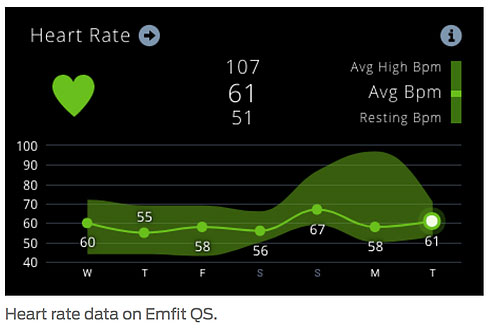
A healthy person should see clear pattern of the heart rate going down as the sleep deepens and up in light and REM sleep.

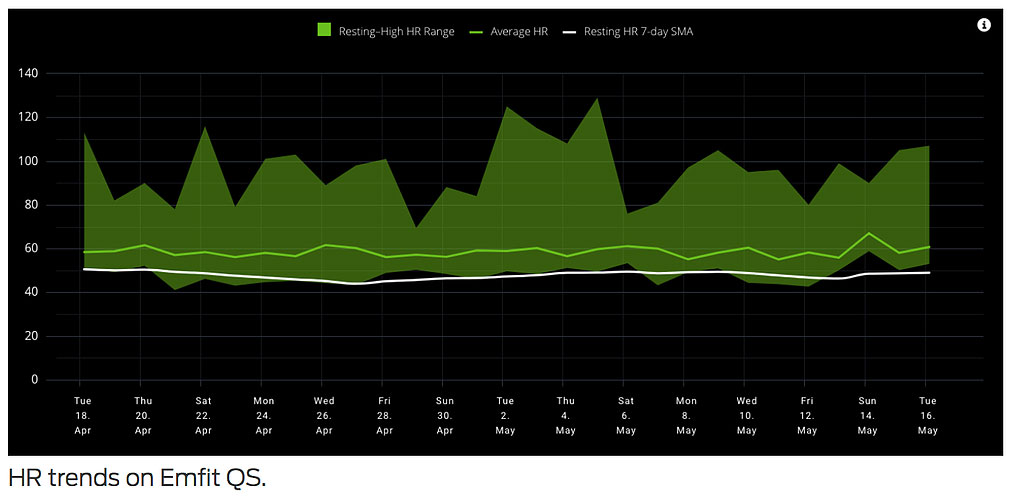
The Average BPM is simply your average heart rate for the whole night. The Resting BPM, on the other hand, is the smallest 3-minute average heart rate you had during sleep. It can be used as a mild indication of stress or overtraining. After you have established your baseline Resting BPM during a couple of weeks, you can keep an eye on notable deviations from this normal Resting BPM level of yours.

The general rule of thumb is that if your Resting BPM bumps up by more than 7 beats per minute, you should consider skipping your workout or opt for something a little lighter and find some ways to relieve your stress. A relaxing bath or a calming walk outside might do the trick, for example. What I love to do when I want to get moving but am feeling too worn down for a hard workout is walk down to the beach near by (and watch the sunset).

Best sleep data tips part 3

Do not let rapid, short-term deviations in Resting BPM with long-term changes confuse you. For example, exercise tends to decrease resting heart rate over time and this only tells that you are getting fitter!

Best sleep data tips part 3

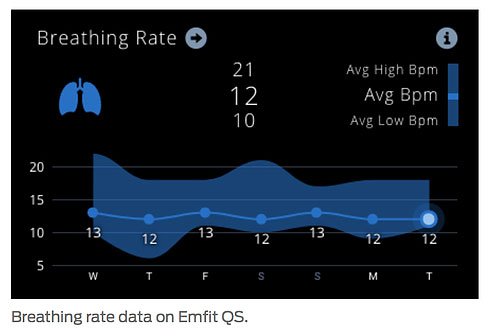
Breathing

Best sleep data tips part 3

Average BPM is simply the average breathing rate for the whole night. The typical breathing rate for a healthy adult at rest is 12 – 20 breaths per minute. 

Best sleep data tips part 3

While it has been argued that vitamin C doesn’t really help prevent colds, taking it before the symptoms of cold hit you may shorten the duration of symptoms. Citrus fruit should be one good option. If you suspect a cold, try taking some vitamins.  Chances are you will still get the cold, but it may not last as long.

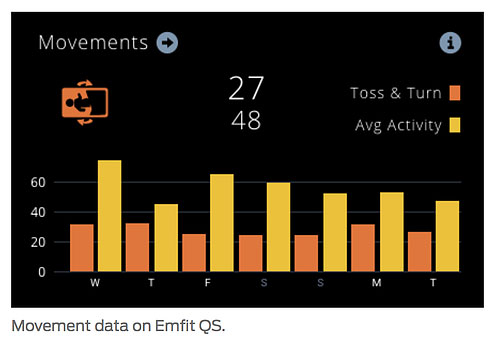
Movements

The movement data gives an indication of how restless your sleep is. If there is lots of activity, your sleep quality is probably poor too. Average Activity measures larger movements than those caused by your breathing and beating heart such as a twitching leg or arm or changing position only slightly. The number of Toss & Turn indicates bigger movements.

Best sleep data tips part 3

A higher value both in Average Activity and Toss & Turn might be a sign of a restless night. I’ve also heard that movement data can also be used to study how hard a training session was. More movement than usual could mean that the workout was hard for your body. However, do remember to inspect these numbers against your own baseline values. A long-term increase in movement data may be an indication of an approaching over training condition. If you notice that your values have increased over a longer period of time, you might want to check if your resting heart rate has been increasing along with a drop in long-term HRV. All of these may be signs of overtraining or your body experiencing too much stress or strain. This means that your body needs more rest.

Thanks for reading! Now that you’ve got a full package of info for using sleep data to your benefit, make sure you leverage it! 

Cheers,
Peppiina

Welcome to our sleep data tips part two to learn more about recovery (HRV) data! Even if you do not use our tracker, I hope reading this will help you understand more about tracking sleep and why it’s so beneficial! I have written about this topic before, but since our app has changed quite a lot since then. That’s why I thought this would be a welcome topic at this point of time. 

Heart rate variability (HRV) is commonly used to measure recovery. It offers especially athletes an effective measure of their ability to do their next workout. HRV gives insight into how well the parasympathetic nervous system (PNS) works. PNS is one part of the autonomic nervous system (ANS). It stimulates the “rest-and-digest” and “feed and breed” activities that happen when the body is at rest. It is complementary to the sympathetic nervous system (SNS), the other part of ANS. The SNS is responsible for stimulating activities associated with the fight-or-flight response. 

We have more than just one recovery graph to give you a deeper understanding of your personal recovery and readiness for strain and stress. There’s HRV RMSSD, total recovery, integrated recovery and autonomic nervous system balance. This may sound like a lot and studying all the data may seem like a daunting task, but that’s why I’m here! I want to give you some tips on how to read and use this data to your own advantage. Who knows, maybe you’ll learn something new!

Best sleep data tips part 2 hrv

Heart Rate Variability RMSSD

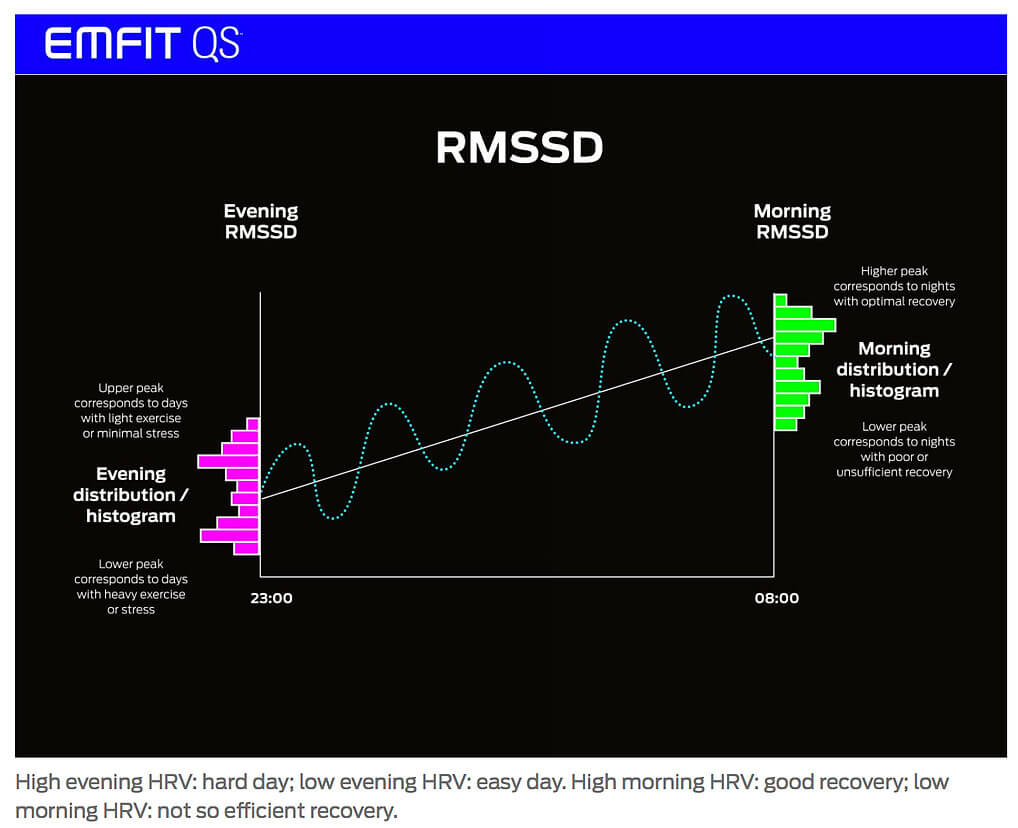
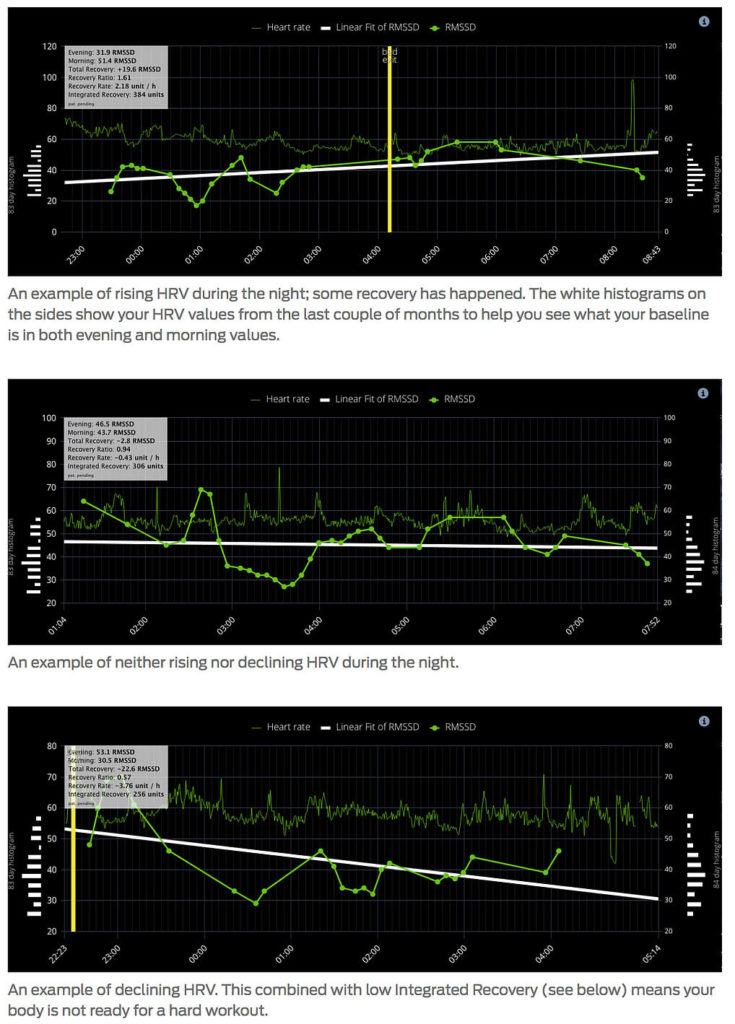
First, we have HRV RMSSD*, (Root Mean Square of Successive Differences), one of the most widely used time domain values of heart rate variability. It tells about the activity of the central nervous system. A higher number indicates better recovery and lower stress, for example.

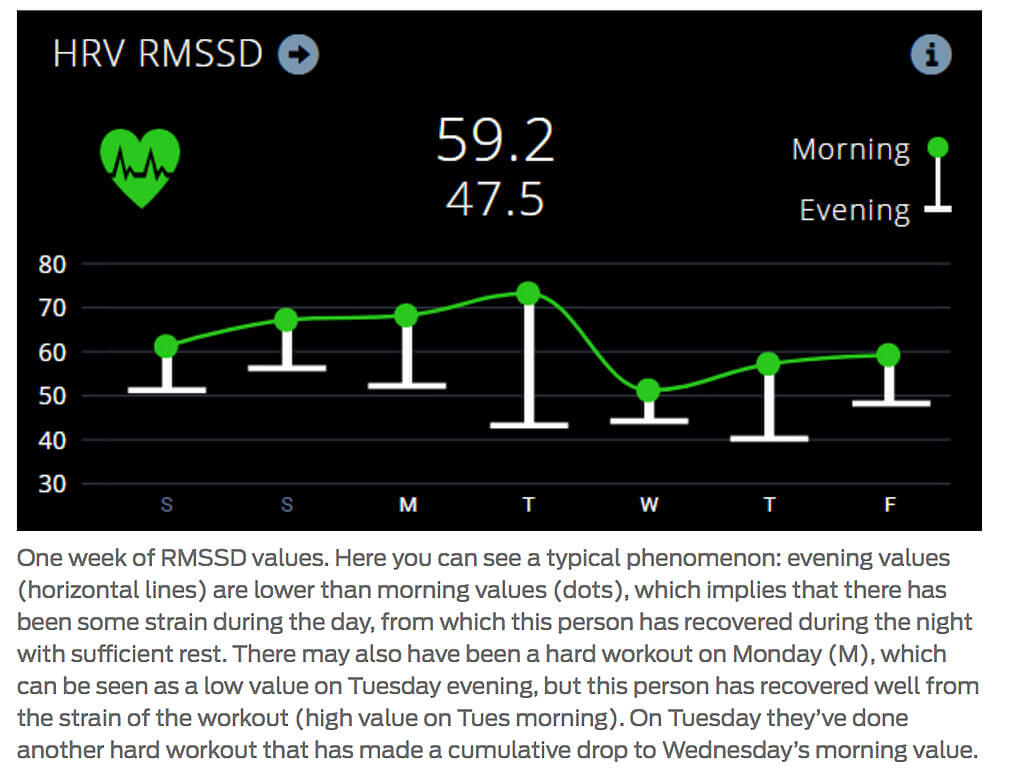
Our app shows both evening and morning values of HRV RMSSD**. A low evening value means that your day has been hard because of either mental stress or physical exercise. Thus, athletes can use the evening value to check whether or not their training has been effective. The morning value should be higher than evening value, meaning that there has been efficient recovery and rest during the night. This shows how ready and well rested your body is for a new day.

Best sleep data tips part 2 hrv

For efficient recovery from training and stress, it is essential that the parasympathetic nervous system is active and your body gets sufficient rest. With the HRV RMSSD value you can keep track of what your general baseline value is and see how hard workouts, stress and other factors like this influence it. When the value goes back to your baseline, you should be capable of doing an another heavy workout. 

RMSSD can be measured in time windows of different lengths and in different positions, like sitting or standing. The RMSSD value is highly individual and depends on age, gender, fitness level, stress level and lifestyle choices, among others. This is why it is smarter to measure your own HRV for a few weeks and only after that make conclusions on what kind of implications different values might have. It should also be noted that the short 1-3-minute morning measurements are pretty flexible. You might get very varying results if you did it many times in a row. This means that one number may tell you to rest and another may encourage you to do a hard workout. That is why it’s wiser to measure HRV throughout the whole night in short time windows. This way you can see the development (or trend) of all the results. 

Generally, higher values indicate for example better health and fitness. In the short term, RMSSD indicates readiness for the day. In the long term, for example along with training, RMSSD values tend to increase (which is a good thing). Long term decrease in RMSSD may be a warning of an approaching over training condition or some other malfunction in your body.

Best sleep data tips part 2 hrv

*Mathematically, HRV RMSSD is the square root of the mean of the squares of the successive differences between adjacent heart’s beat-to-beat intervals.

** The morning HRV RMSSD value we use is the average of all 3-minute time window values measured during the last 90 minutes prior to waking up. The evening value is similarly measured within the first 90 minutes in bed.

Best sleep data tips part 2 hrv

Total Recovery

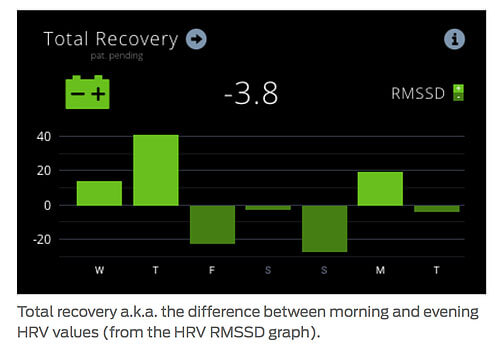
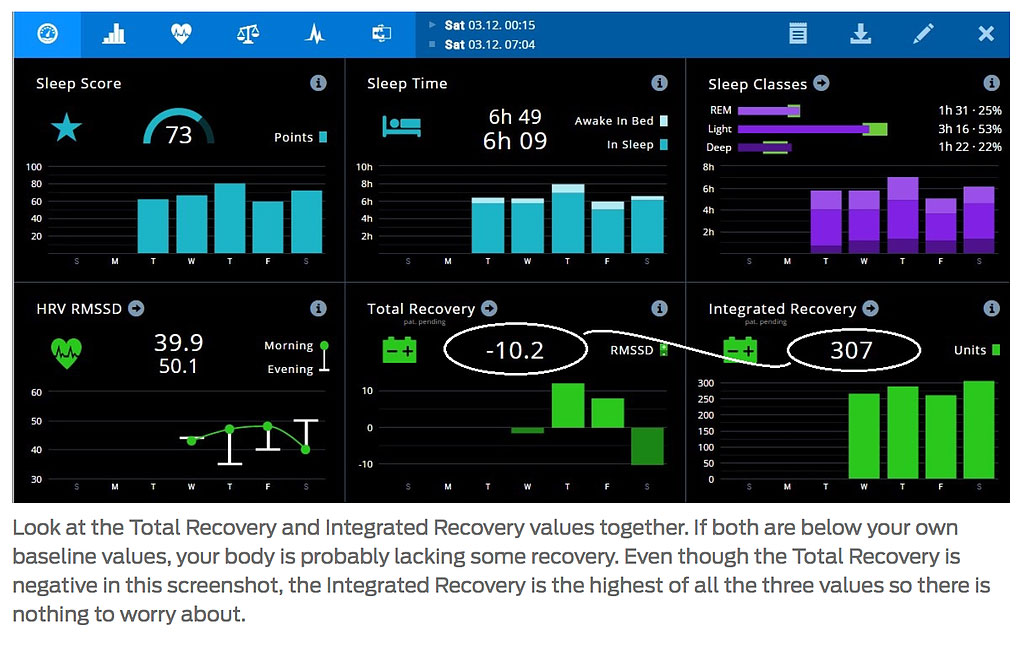
Next up we have Total Recovery, which simply is the difference between morning and evening HRV RMSSD values. Usually this value should be positive, indicating that you have got enough rest during the night to allow your body to recover. However, you should look at this with regard to the activities of the day before. If you had a very easy and light day (no stress and no heavy exercise) and your evening RMSSD was relatively high, it is not even reasonable to expect a high total recovery value. It is just that here simply is no stress or strain to recover from.

Next up we have Total Recovery, which simply is the difference between morning and evening HRV RMSSD values. Usually this value should be positive, indicating that you have got enough rest during the night to allow your body to recover. However, you should look at this with regard to the activities of the day before. If you had a very easy and light day (no stress and no heavy exercise) and your evening RMSSD was relatively high, it is not even reasonable to expect a high total recovery value. It is just that here simply is no stress or strain to recover from.

Remember that recovery values are highly individual. Everyone has their own baseline values and you should compare yours to your own baseline values. It is also wise to compare your own morning values to your evening values, which is why we’re about to take a look at another graph that does just that.

Integrated Recovery

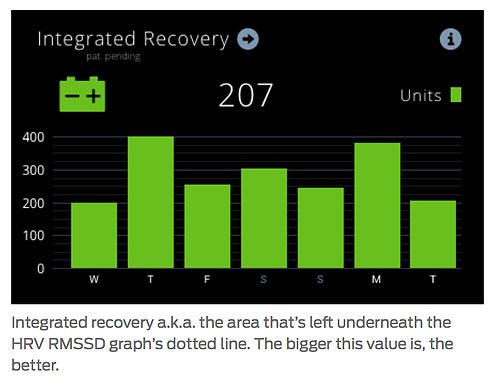
Integrated Recovery is the area that can be seen under the HRV RMSSD graph. It is an indicator for how much recovery you’ve gotten during sleep. For example, some people may start to recover very nicely (RMSSD graph shooting upwards) in the first hours of the night, after they go to bed and fall asleep. But towards the morning hours they may start to become anxious (for example because of work stress) and their RMSSD starts to decline. As a result, the morning RMSSD may be quite low when compared to the evening RMSSD, thus indicating poor recovery, even though there has been some good recovery during the night. This is where integrated recovery steps in, as it takes this good recovery from earlier in the night into account.

Best sleep data tips part 2 hrv

Integrated Recovery and Total Recovery should be looked at as a pair. On the one hand, even if your Total Recovery is low, but the Integrated Recovery is medium or high (with regard to your own history!), some recovery has happened during the night. On the other hand, if both of these values are low, recovery is probably not sufficient. In this case you should avoid straining yourself too much by for example avoiding hard workouts.

Best sleep data tips part 2 hrv

ANS Balance

Autonomic Nervous System Balance tells whether you’re too excited (high LF value) or too phlegmatic (high HF value)*. The diagram displays both LFn and HFn**. What you need to remember here is that ideally, the indicator should stay near the 50-50 shaded line between values of 25 and 75. Deviation beyond 25-75 or 75-25 line may be a sign of insufficient recovery, high or chronic stress, general fatigue or some other malfunction in your body. 

* LF and HF refer to Low Frequency and High Frequency, respectively, and they both are common frequency domain measures of heart rate variability. LF is the area measured in a frequency band of 0.04-0.15 Hz. It is considered a state indicator of both sympathetic/parasympathetic nervous systems. HF is the area measured in a frequency band of 0.15-0.4 Hz. It is considered a state indicator of parasympathetic nervous systems.

** In our system we use normalized units LFn and HFn. The normalized units have been expressed as a percentage of the sum of LF+HF, i.e. LFn=LF/(LF+HF).

Trends

Best sleep data tips part 2 hrv

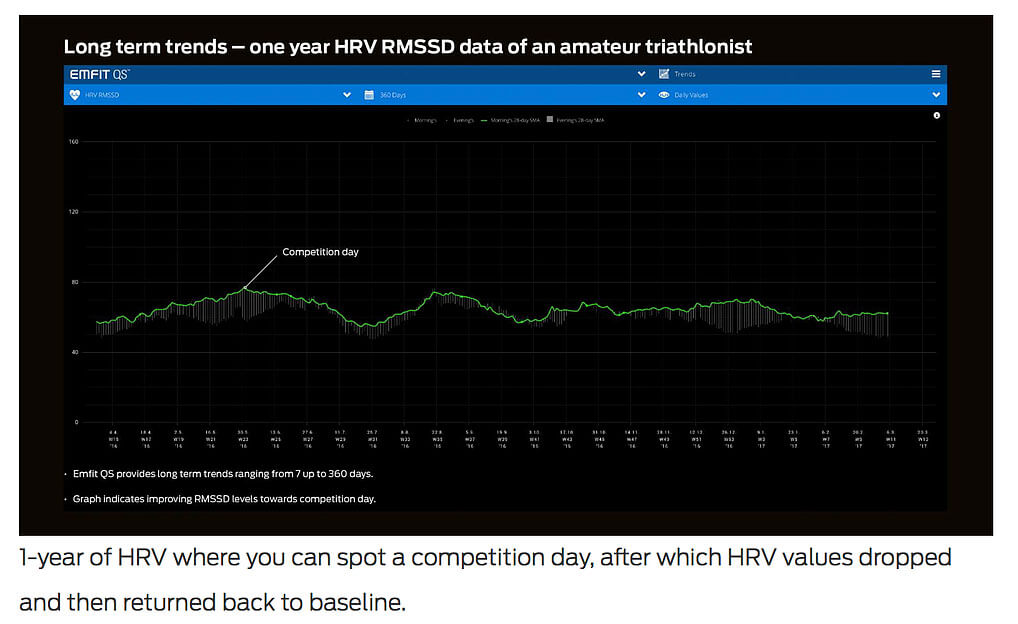
1-year of HRV where you can spot a competition day, after which HRV values dropped and then returned back to baseline. 

This is one of my favorite parts of Emfit QS. Trends are great for tracking your own progress. I think it’s exciting to look back to your data and see what kinds of effects training has had. A steadily rising HRV throughout a long period of time hints about an improvement in your health and physical condition. All that hard work was not for nothing. A steady, declining trend with no ups whatsoever on the other hand is a warning sign. Watch out: you might be wearing yourself out, slow down before it’s too late!

Wrap Up

Well this has been quite a big chunk of info. I want remind you that our recovery graphs are kind of connected and it’s important to look at them as a package. Another important issue to remember is that HRV data is very individual. There is no use of comparing your own values to someone else’s. Measure your HRV until you start to see your own baseline and make conclusions based on changes to that level. Hope this was useful and helps you leverage your HRV data! 

XX,
Peppiina

I hope you all have been sleeping well during the holidays! However, did you know that it is possible to get too much sleep? According to recent research, getting too much sleep is actually just as bad to you as getting too little sleep. Catching too many Zz’s over and over again may be a sign of an underlying medical condition, and it also puts your health in risk. A healthy amount of sleep per night lies around eight hours. Here are a few things you are risking health-wise, if you’re getting too much sleep night after night.

Fit and Fabulous

If you’re either trying to lose some a few pounds or just wish to remain the hot fox or stud you are, you may want to make sure you aren’t constantly getting too much sleep. According to one research, those who sleep eight hours ore more have greater increases in belly fat over a five-year period. And just for the record, the same goes for those who average under seven hours of sleep per night. According to National Sleep Foundation, “sometimes the best way to treat obesity can be to treat an underlying sleep problem”. 

One US study showed that people who got nine to ten hours of sleep every night were 21% more likely to become obese over a six-year period, compared to people who got seven to eight hours of sleep per night. This association remained the same even when eating habits and exercise were taken into account.

Avoiding Depression

Even though insomnia is linked to depression, 15% of people who are depressed sleep too much. As regular sleeping patterns are crucial to recovery, getting too much sleep can make depression even worse. When it comes to healthy people, getting too much (or too little) sleep increases the heritability of depressive symptoms

In a study, participants who were sleeping between seven and nine hours, had a 27% heritability of depressive symptoms, whereas sleeping nine hours or more increased the percentage to 49.

"Don't Forget!"

Getting too much sleep has risks

Both too much and too little sleep can be bad for the aging brain. A group of women taking part in the Nurses’ Health Study were asked about their sleep habits in 1986 and 2000. They were interviewed about memory and thinking skills three times over a later six-year period. 

What was found was that womenwho slept too much or too little had changes in brain functioning that made them mentally two years older, compared to those who got enough quality sleep.

Hoping to Get Pregnant?

In 2013, a team of Korean researchers analyzed sleep habits of women undergoing IVF. The women were broken into three groups: short sleepers (less than 6 hours of sleep per night), moderate sleepers (7-8 hours), and long sleepers (over nine hours). Results showed that moderate sleepers had the highest pregnancy rate, whereas short and long sleepers came about 10% behind. 

According to the study’s authors, getting enough sleep benefits reproductive hormone secretion. Moreover, the real reason behind decreased fertility here may be the fact that excess sleep can cause various health issues, all of which can affect fertility.

Increased Risk of Diabetes

raspberry, sugar, spoon

In a small study, researchers found that people who slept more than eight hours a night were twice as likely to develop type 2 diabetes or impaired glucose tolerance over a six-year period than those who slept between seven and eight hours a night. Even after taking into account body mass among the subjects, the risk of diabetes and insulin resistance was still twice as high among those who got too much or too little sleep.

Staying Healthy

Short sleep exposes the body to mild inflammation, but a recent study found that so does sleeping too much. The study, conducted in Kuopio, Finland, examined the health and lifestyle of middle-aged men. Short sleep (<6 hours) and long sleep (>10 hours) were found to be linked to mild degree of inflammationcompared to 7-8 hours of sleep. They also investigated the blood element concentration in relation to duration of sleep. High copper concentration in blood was linked to long duration of sleep. Copper helps the body make melanin, bone, and connective tissue. 

Lifestyle choices such as diet and exercise influence copper levels, as well as other micronutrient concentrations in the body. Too much copper is toxic to organs, killing liver cells and harming the nervous system. It can also create an imbalance in zinc and iron in the body.

Heart Problems

Getting too much sleep has risks

Short sleepers are more likely to suffer from stiffened arteries and calcium deposits on the walls of their major arteries. Coronary calcium develops long before heart attack symptoms occur, and a greater amount of calcium in the coronary arteries predicts future development of heart disease. According to one study, participants who got five or fewer hours of sleep a day had 50% more calcium in their arteries than those who slept seven hours a day, while those who slept nine or more hours had at least 70% more calcium compared to those who got 7 hours of sleep, and those who reported poor sleep quality had over 20% more calcium than those who reported good sleep quality. 

One study in the US involved nearly 72,000 women and showed that women who slept over nine hours a night were 38% more likely to have coronary heart disease than those who got eight hours of sleep.

Adequate Sleep = Longer Life

Life expectancy has been getting longer and longer, but did you know that getting too much or too little sleep is linked to a greater risk of death? Sleeping over eight hours a night was associated with a 1.3-times bigger risk of death among the 1,382,999 various study participants. 

A specific reason for this correlation hasn’t been determined. However, depression and low socioeconomic status are associated with longer sleep. So, these could be linked to the increase in mortality for people who sleep too much.

We at Emfit Want to Help You!

Getting too much sleep has risks

With Emfit QS you can measure sleep quality and quantity, as well as recovery with zero effort. Once you have installed it, all you ever have to do is go to sleep and check the results whenever you want! Emfit QS measures your heart/respiratory rates and heart rate variability throughout the entire night, and tells you all about the quality of your sleep with our 3-class sleep classification (light, deep, and REM sleep). When it comes to sleeping too much, our current Sleep Score algorithm doesn’t punish you for an overly long sleep period – yet – we are thinking about changing it into that direction. 

So, how about, if I challenge you all to make a New Year’s resolution: getting an average of 8 hours of sleep a night to stay healthy! Who’s in!? 

Cheers, 

Peppiina

Since there’s been so much talking going on regarding the Volkswagen emission scandal, I thought, why not talk about something related to the whole cars and driving scene. A serious topic as well, but in a different way. 

How many times have you been dead tired while driving, but haven’t stopped to take a nap? I bet all of us are guilty of that crime. Did you notice what I just did there? I said crime, and I actually did do that on purpose. Most of us probably just grab a cup of coffee to go and think they’ll be just fine, and most likely will even make it home safe. Then, when it’s a question of driving drunk, there are all kinds of campaigns and even the law telling us how wrong it is to drive when intoxicated. However, did you know that most car crashes in the U.S. don’t actually involve alcohol, and most people in car crashes are wearing seat belts? We are aware of the dangers of alcohol and the need to buckle-up, but drowsy driving still is an under-appreciated danger.

Drowsy Driving Facts

Drowsy driving - legal but lethal

Car crashes rank among the leading causes of death in the United States.According to the National Highway Traffic Safety Administration (NHTSA) drowsy driving in the US alone causes approximately 100,000 crashes a year. This results in an estimated 1,550 deaths, 71,000 injuries, and $12.5 billion in monetary losses. Studies have shown that a driver who has gone a day without sleep is very similar to a driver with a blood alcohol level of 0.10%, which well above the legal limit. Just like alcohol, sleepiness slows reaction time, decreases awareness, and impairs judgment and vision, thus increasing the risk of crashing. Yet we underestimate the seriousness of drowsy driving.

Conclusion

Drowsy driving is just as dangerous as drunk driving. It is a real public health issue and deserves more attention, education, and policy initiatives. Many lives could be saved and disability avoided if drowsy driving was taken more seriously. So next time when you’re speeding through a dark highway in the middle of the night and your head is starting to nod and your eyelids feel super heavy, pull over and take a nap. Don’t you think that making it to your destination 20 minutes later than scheduled is worth possibly saving a life – yours, someone else’s, or maybe even that of someone you love. 

Cheers,
Peppiina

Overview

Have you ever struggled with a weight loss goal? Wondered why nothing’s happening to your belly and numbers on the scale don’t change even though you’ve been rigorously following your diet and exercise plan? Would you believe me if I told you that you could start seeing results simply by sleeping? 

In a 2004 study, participants who got less than eight hours of sleep a night had reduced leptin and elevated ghrelin, and higher BMI. A newer study suggests that increasing the amount of sleep adults get could lead to eating less, but the hormonal process differs between men and women. According to the study’s principal investigator, Marie-Pierre St-Onge, PhD, FAHA “Restricting sleep in healthy, normal weight participants has limited effects on metabolic risk factors and may affect food intake regulating hormones differently in men and women.” The team was surprised by how sleep duration doesn’t affect glucose, insulin and leptin levels, and by sex differences in the hunger-stimulating hormone ghrelin and the satiety hormone GLP-1.

How does sleep boost weight loss?

The best-kept weight loss secret
Can sleep boost weight loss?

The study, conducted in 2012, tracked sleep duration, glucose dysregulation, and hormonal regulation of appetite in 27 normal weight, 30- to 45-year-old men and women. Fasting blood samples were obtained daily, and participants were studied under two sleep conditions: short (4 hours in bed) or habitual (9 hours in bed). Short sleep increased total ghrelin (the hunger hormone) levels in men but not women and reduced GLP-1 (the satiety hormone) levels in women but not in men. This sex difference has not been reported before. 

If you’re not getting enough sleep you might also be less eager to work out. This is because fatigue could influence not just decisions like whether you eat a bar of chocolate, but also whether or not to break a sweat. Besides, when you’re tired, you’re more likely to simply give in to impulse of temptations. And guess what else can cause your diet to fail? Chronic stress. That’s because stress triggers the body to release cortisol, an appetite-stimulating stress hormone, which makes your body more likely to store fat. That’s the type of weight gain that increases your risk of serious health problems. What can help reduce stress? Yup, you got it right – the answer is sleep. When tired, you are less patient and more easily agitated, which can increase stress. A good night’s sleep helps you to tackle the day’s stress more easily.

Rest Up, Slim Down

man, runner, running

The current research focuses on sleep deprivation leading to weight gain rather than an increase in sleep leading to weight loss. According to the National Sleep Foundation, the average adult gets only six hours and 51 minutes of sleep on weeknights. But, most people actually need seven to nine hours of sleep a night. Note that the quality of sleep also is important. If you’re not getting enough of REM and deep sleep, your mind and body will not recover, meaning that your mental functions and physical condition will suffer. 

The results of the study point to the complexity of the relationship between sleep duration and energy balance regulation. The state of energy balance (whether someone is in a period of weight loss or weight gain) may be critical in the metabolic and hormonal responses to sleep restriction. According to the authors, this is the largest controlled clinical investigation of the effects of sleep reduction on hormonal regulation of food intake. The results suggest that the common likeliness to overeat due to sleep loss is derived from reduced feelings of fullness in women and increased appetite in men.

The best-kept weight loss secret

Bottom line: In order to achieve your weight loss goals and also ensure that you won’t gain weight, make sure you’re getting enough sleep.

Smiles,
Peppiina

The Russian Doping Scandal

I bet many of us have heard about the Russian doping scandal. If not, let me explain it to you in a few words. On November 9, an independent commission set up by the World Anti-Doping Agency confirmed Russian track and field athletes have widely been using performance enhancing drugs and blood doping. All this was encouraged and covered-up by coaches, doctors, and state and sports officials. In result (so far), Russian athletes were suspended from sport by IIAF.

What still remains a question mark, is that will Russian athletes be allowed to compete in the Rio 2016 Olympics. The World Anti-Doping Agency commission wants the Russian athletics federation to be barred from international competition. The International Olympic Committee would also consider barring not only athletes, but also individual coaches and officials from future Olympic Games. There are also concerns about unfair wins by Russian athletes, and whether champions may have their medals withdrawn.

track and field, sport, sprint

U.S. Olympic Cycling

We all probably also remember the Lance Armstrong doping scandal. Armstrong was accused for engineering one of the most sophisticated doping schemes in sports. In 2012, the U.S. Anti-Doping Agency stripped Armstrong of his seven Tour de France victories and banned him for life from racing. This resulted in all top U.S. men’s cyclists being withdrawn from the 2012 London Olympics. The U.S women’s cycling team – Dotsie Bausch, Sarah Hammer, Jennie Reed, and Lauren Tamayo – remained the only medal hope. However, the women’s team had no hope according to all data available. The U.S. women hadn’t won a track medal in 20 years and they had no assets to go after the podium spot. At least not the traditional way. 

The team turned to their own data, measuring every possible thing about their bodies with fitness trackers and any device available. All to enhance their performance. They got Sky Christopherson, a former USA Cycling teammate, to work with them. “The year before, after a decade away from competitive cycling, and after suffering a heart attack scare in December 2009, Christopherson had set a master’s world record, 10.49 seconds, in the 200-meter velodrome sprint. His return to form had been based on a data-driven training approach inspired by Dr. Eric Topol, digital medicine researcher and director of the Scripps Translational Science Institute.”

Emfit QS - Measure Heart Rate Variability, data bike riding, fast moving, bike

Data Instead of Doping

Blood analysis found that Hammer had a severe vitamin D deficiency. She started taking supplements and was advised to get outside and get more direct sunlight. DNA testing showed that Bausch, who lacked speed on the track, surprisingly had the sprinter’s gene. Her training was adjusted to leverage that detail. But perhaps more importantly, the knowledge boosted her confidence. And a sleep tracker indicated that Reed needed to get more rest. 

The amount of data the team was collecting was overwhelming. They needed help at processing the massive volume of information and searching for connections. Christopherson reached out to Stefan Groschupf at data analytics firm Datameer. With Groschupf’s help they found, for example, that the athletes got more deep sleep when their bodies were at a lower temperature. They also found that more deep sleep translated into more power on the track the following day. Why? Deep sleep is where our bodies release human growth hormone and testosterone naturally, helping the body recover. To enable the athletes to get more deep sleep, they used air conditioning units and water-cooled mattresses. This way they used data to boost those chemicals, instead of drug

runner, jogging, morning

In Olympic qualifying nothing seemed to go right, but the team rode the fastest they had ever ridden. And miraculously, they got their game together right before it was too late, and qualified for the final. In the final, though, the British team of Danielle King, Laura Trott, and Joanna Rowsell were too strong. They beat the Americans by more than five seconds. Anyhow, it was a victory for the U.S. team. In just three months they had transformed from Olympic outsiders to silver medalists.

Olympic Athletes + Emfit QS

We at Emfit wanted to solve the problem of tracking health without having to wear anything. We also wanted to make it as simple as possible. The result was Heart-Rate-Variability enabled Emfit QS Sleep Monitor. Today, the device is one of the many that Sky Christopherson is using with Olympic athletes.

Working with Olympic athletes, we use ‘Data not Drugs’ to boost every aspect of athlete health and performance. New technologies are enabling us to help athletes get exciting results, including 5 Olympic medals in the most recent Olympics. Moral and health arguments aside, we believe using data to leverage the natural strengths of our bodies will always win over the long run. Since sleep is foundational to health and performance, it is a focal point of our program and we have used every sensor on the market. The Emfit system is creating new capabilities in understanding sleep both with the goal of improving it, but also using it to better inform training decisions as we moved towards truly individualized training models. The ease of use and accuracy of Emfit is also unprecedented. As a result, the Emfit system is now an integral part of our ‘Data not Drugs’ program as we build a future that uses more data and less drugs, in sport, and hopefully in health.

– Sky Christopherson, World Record Holder and Founder, OAthlete 

Athletes have been using doping for a long time. Sometimes, when out of luck, they get caught with serious consequences. That is just what the Russian doping scandal has showed us. The solution to this problem is already available, but not used to its full potential. Modern technology enables us to do things that no one thought were possible. The U.S. cycling team clearly proved this. By using only data, they surprised everybody and broke all expectations. I firmly believe that this is the future of enhancing sports performance. No doping, just data. The greatest thing about it is that it’s 100% legal. Maybe this is something the Russian track and field team should consider, too. 

Cheers,
Peppiina