
Sleep research without limitations
Reliable, contact-free measurement for a deeper understanding of sleep and human physiology.
Why EMFIT QS™ for research?
Research data without attaching anything to the participant
EMFIT QS™ is installed under the mattress and operates automatically without requiring the participant to wear, charge, or interact with a measurement device. Once installed, measurement starts automatically when the participant goes to bed.
This makes EMFIT QS™ particularly well suited for repeated and long-term measurements during sleep and rest, including studies conducted in participants’ normal sleeping environments. The unobtrusive measurement method minimizes participant burden and helps reduce the risk of missing data caused by participants forgetting to wear, charge, or activate a measurement device.
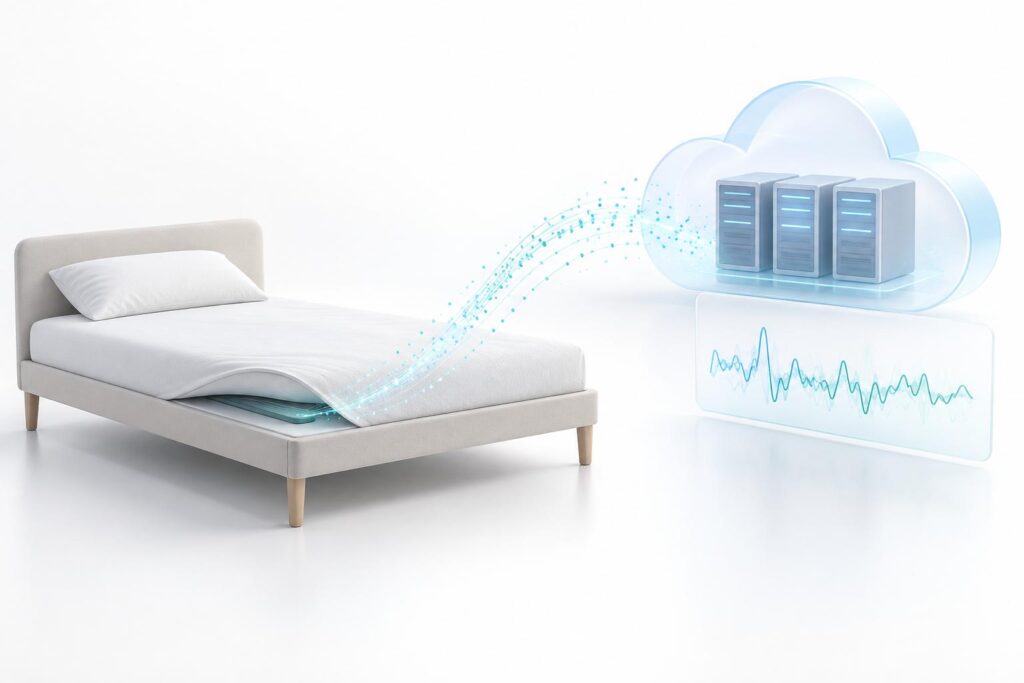
Data is automatically transmitted to the EMFIT® cloud through Wi-Fi or cellular connectivity, processed and stored securely, and made available through the web application or APIs. Researchers can therefore collect data over extended periods with very little day-to-day involvement from either the participant or the research team.
Physiological and sleep data for research
Physiological data
- Heart rate
- Respiratory rate
- Heart rate variability (HRV) RMSSD
- Autonomic Nervous System (ANS) Balance
Sleep, movement and presence
- Sleep/wake
- Sleep stages
- Sleep duration and sleep efficiency
- Movement activity, tossing and turning, and restlessness
- Bed presence
Sensor-level data
- Raw BCG waveform at 100 Hz sampling rate
- 200 Hz sampling available by special order
Data at different time scales
EMFIT QS™ provides multiple levels of data for research. Researchers can use ready-calculated physiological and sleep parameters, timestamped events and sleep-period summaries, or access the underlying BCG waveform for their own signal processing and analysis.
Physiological and time-series data
| Data | Resolution |
|---|---|
| Heart rate | 4 s* |
| Respiratory rate | 4 s* |
| Movement activity | 4 s* |
| Sleep stages | 30 s |
| HRV RMSSD | 3 min |
| ANS Balance | 3 min |
| Sleep period summary metrics | Per sleep period |
Autonomic Nervous System (ANS) Balance is a derived HRV measure based on the low-frequency (LF) and high-frequency (HF) components of heart rate variability. It is designed to characterize changes in autonomic balance during sleep and is calculated at 3-minute intervals, allowing both within-sleep-period and longitudinal trend analysis.
Sleep and movement data
In addition to physiological parameters, EMFIT QS™ provides information describing sleep, movement and bed occupancy, including:
- Sleep/wake
- Sleep stages
- Movement activity and restlessness
- Tossing and turning
- Bed presence
- Sleep duration and sleep efficiency
Timestamped event data
Selected events are recorded with timestamps, allowing researchers to analyze when specific events occurred within a measurement period.
Available event data includes:- Bed entry and exit events
- Tossing and turning events
- Snoring events with start and end timestamps
Depending on the study configuration, selected events can also be delivered through the Live Data API when they occur.
Sleep period summary data
After a sleep period has been completed and processed, EMFIT QS™ provides summary metrics describing the entire recorded period.
These include:
- Sleep duration
- Sleep efficiency
- Sleep onset and end times
- Duration of individual sleep stages
- Other calculated sleep-period summary metrics
This provides researchers with both detailed time-series data and ready-calculated period-level results for longitudinal analysis across nights or measurement periods.
BCG waveform data
For research teams that want to work closer to the original sensor signal, EMFIT QS™ can provide access to the underlying ballistocardiographic (BCG) waveform.
Standard research configuration: 100 Hz sampling Special-order configuration: 200 Hz sampling
Waveform data can be used for independent signal analysis, algorithm development, validation studies and other research applications where access to sensor-level data is required.
Use our algorithms — or work closer to the signal
Researchers can therefore choose the level of data that best fits their study: ready-calculated physiological and sleep parameters, timestamped events, processed sleep-period summaries, or high-frequency BCG waveform data for their own analysis.
Data access and APIs
Choose the data access that fits your study
From live physiological measurements and current device status to fully processed sleep periods and high-frequency BCG waveform data, EMFIT QS™ provides several ways to access research data.
Researchers can use one or several APIs depending on the study design. Data can be delivered automatically to the research organization’s systems, allowing EMFIT QS™ to become part of an existing research data infrastructure.
| Sleep Period API | Live Data API | Status API | Raw Signal API |
|---|---|---|---|
| Post-processed | During measurement | Current status | Sensor waveform |
| HR · RR · HRV · ANS · Sleep | HR · RR · Activity · Events | In/out of bed · Data connection | BCG · EDF |
| After period completion | Every 30 s + events | Current state | 100 / 200 Hz |
Sleep Period API
Complete processed datasets after each measurement period
The Sleep Period API provides a complete processed dataset after a recorded sleep period has ended. The dataset includes physiological time-series data, sleep and movement data, calculated HRV and ANS parameters, events, and sleep-period summary metrics.
By default, a sleep period is completed when the participant leaves the bed and does not return within 20 minutes. The recorded period is then finalized and post-processing is performed, including sleep staging, HRV and ANS calculations.
For studies where participant-defined sleep periods are not suitable, processing can instead be scheduled at fixed 6, 8, 12 or 24-hour intervals, with a configurable start time.
The standard minimum sleep-period duration can be configured down to 20 minutes. For research requiring much shorter periods, special configurations can provide processed periods as short as one minute.
Processed Sleep Period data can include:
- Heart rate, respiratory rate and movement activity at 4-second intervals
- Sleep stages at 30-second intervals
- HRV RMSSD and ANS Balance at 3-minute intervals
- Bed presence and timestamped events
- Sleep duration, sleep efficiency, sleep-stage durations and other period-level metrics
- Snoring events with start and end timestamps
Live Data API
Access physiological and movement data while the measurement is in progress
The Live Data API provides data without waiting for the current sleep period to end and post-processing to be completed.
Heart rate, respiratory rate and activity data, including tossing and turning, can be pushed to the research organization’s system at 30-second intervals.
Selected events can also be included when required by the study. When event delivery is enabled, events are pushed when they occur rather than waiting for the completed Sleep Period dataset.
This allows researchers to combine near-real-time data access with the more comprehensive post-processed datasets provided by the Sleep Period API.
Status API
Know whether the participant is in bed — and whether data is being received
The Status API provides the current measurement status independently of the physiological data stream.
It indicates whether the participant is currently in bed or out of bed, and separately whether data is being received from the EMFIT QS™ device. The status information also includes how long the current state has continued and the device timestamp of the most recently received data.
This is particularly useful in remote and long-term studies, where researchers may need to distinguish between a participant simply being out of bed and missing data caused by a device or connectivity issue.
Raw Signal API
Access the BCG waveform for your own analysis
For researchers who want to work with the underlying sensor signal, the Raw Signal API provides access to the digitized BCG waveform before digital signal processing and algorithmic analysis.
The signal is conditioned only by the analog front end before digitization and is provided in EDF format for independent analysis.
Standard research configuration: 100 Hz sampling
Special-order configuration: 200 Hz sampling
This enables research teams to use EMFIT QS™ as a data-acquisition platform while performing their own signal processing, algorithm development, validation or other analysis independently of EMFIT’s calculated parameters.
Flexible data delivery
Designed to fit your research infrastructure
EMFIT QS™ supports several methods for delivering research data to the organization’s own infrastructure. Depending on the study requirements, processed data, live data, events, status information and waveform data can be delivered using:
HTTP / Webhook· AWS S3 · Azure Blob Storage · SFTP
Available formats include JSON and EDF, depending on the data type and selected configuration.
For studies generating larger datasets, particularly high-frequency BCG waveform data, direct delivery to cloud storage such as AWS S3 or Azure Blob Storage can provide a practical alternative to conventional API-based transfer.
For larger or technically more demanding studies, the data-delivery architecture can be agreed with the research team in advance to fit the study’s existing infrastructure, security requirements and data workflow.
Secure and automated data delivery
Data delivery can be automated without polling the EMFIT cloud. Depending on the selected integration, Emfit can push data to the research organization’s endpoint or deliver datasets directly to AWS S3, Azure Blob Storage or SFTP.
Integration security options include IP allowlisting, token-based authentication, custom HTTPS authorization headers and server-to-server OAuth. For file-based delivery, optional gzip compression and AES-256 encryption are also available.
Deployment in your own cloud
For larger research deployments, EMFIT software can be deployed in your organisation’s own AWS, Azure, or Google Cloud environment, giving you greater control over data location and infrastructure.
Our software is available as Docker containers. Deployment can be handled by Emfit or your own IT team, with responsibilities and support agreed for each project.
Contact us to discuss your study’s requirements and deployment options.
Flexible connectivity for different study settings
Deploy in the lab — or directly in participants' homes
EMFIT QS™ is available with either Wi-Fi or cellular connectivity, allowing the connectivity model to be selected according to the study environment and deployment requirements.
Wi-Fi is a practical choice for laboratories, hospitals, research facilities and other environments where a suitable network is already available. Once configured, EMFIT QS™ automatically transmits measurement data to the EMFIT cloud without requiring interaction during normal use.
Cellular connectivity is particularly well suited for decentralized, multi-site and home-based studies. Cellular units are delivered with connectivity already configured and can connect automatically when powered on. The participant does not need to provide Wi-Fi credentials, install an app, create an account or pair the sensor with another device.
This makes it possible to ship a preconfigured EMFIT QS™ directly to a participant’s home. Once the sensor is placed under the mattress and connected to power, measurement and cloud data transmission can operate automatically.
Minimal participant interaction
Nothing to wear. Nothing to charge. No app required.
Once installed under the mattress, EMFIT QS™ can operate automatically throughout the study. Measurement starts when the participant goes to bed, data is transmitted automatically, and there is no wearable device that needs to be remembered, charged or synchronized. With the cellular configuration, even local network setup is eliminated.
From a single sensor to large distributed studies
The same EMFIT QS™ platform can be used for a pilot study with a single sensor or for larger studies involving tens or hundreds of participants.
For larger deployments, devices can be prepared and preconfigured before shipment. Cellular units can be shipped directly to individual participants, making them particularly suitable for geographically distributed and longitudinal studies where minimizing participant and research-site workload is important.
Used in scientific research around the world
More than 100 scientific and clinical publications
EMFIT sensor technology has been used in more than 100 scientific and clinical research publications across a wide range of fields, including sleep research, cardiology and ballistocardiography, respiratory research, neurology, long-term care, human performance and other applications.
EMFIT QS™ has been used in laboratory and real-world studies ranging from comparisons with polysomnography and actigraphy to longitudinal measurements conducted in participants’ homes.
We believe independent research is important. Our publications library therefore includes studies reporting a wide range of findings, including studies evaluating the capabilities and limitations of EMFIT technology.
Intended Use – EMFIT QS™ Research Offering
The EMFIT QS™ Research Offering is intended for the contact-free collection and analysis of physiological, sleep, and movement-related data during sleep and rest.
It is designed particularly for scientific and clinical research where unobtrusive, repeated, or long-term measurements are beneficial, including studies conducted in laboratories, clinical research environments, and participants’ normal sleeping environments.
EMFIT QS™ may be used to collect research data from study participants, including participants in clinical studies. However, EMFIT QS™ is not a medical device and is not intended to be relied upon for patient monitoring, diagnosis, treatment, or clinical decision-making.
Physiological and sleep-related parameters provided by EMFIT QS™ are intended as research data and should be interpreted within the context of the applicable study protocol.
EMFIT QS™ Cloud API and Data Integration
Learn how EMFIT QS™ research data can be integrated into your own systems and data infrastructure. Our technical overview covers push-based data delivery, Sleep Period, Live Data and Status APIs, raw BCG waveform access, direct delivery to AWS S3, Azure Blob Storage and SFTP, as well as authentication and security options.