
Ballistocardiography
What is ballistocardiography?
Ballistocardiography (BCG) measures the small mechanical forces generated by the cardiovascular system as the heart ejects blood and blood moves through the large vessels.
Each heartbeat produces minute forces that cause tiny movements of the body. These movements can be detected by a sufficiently sensitive sensor and recorded as a ballistocardiographic waveform.
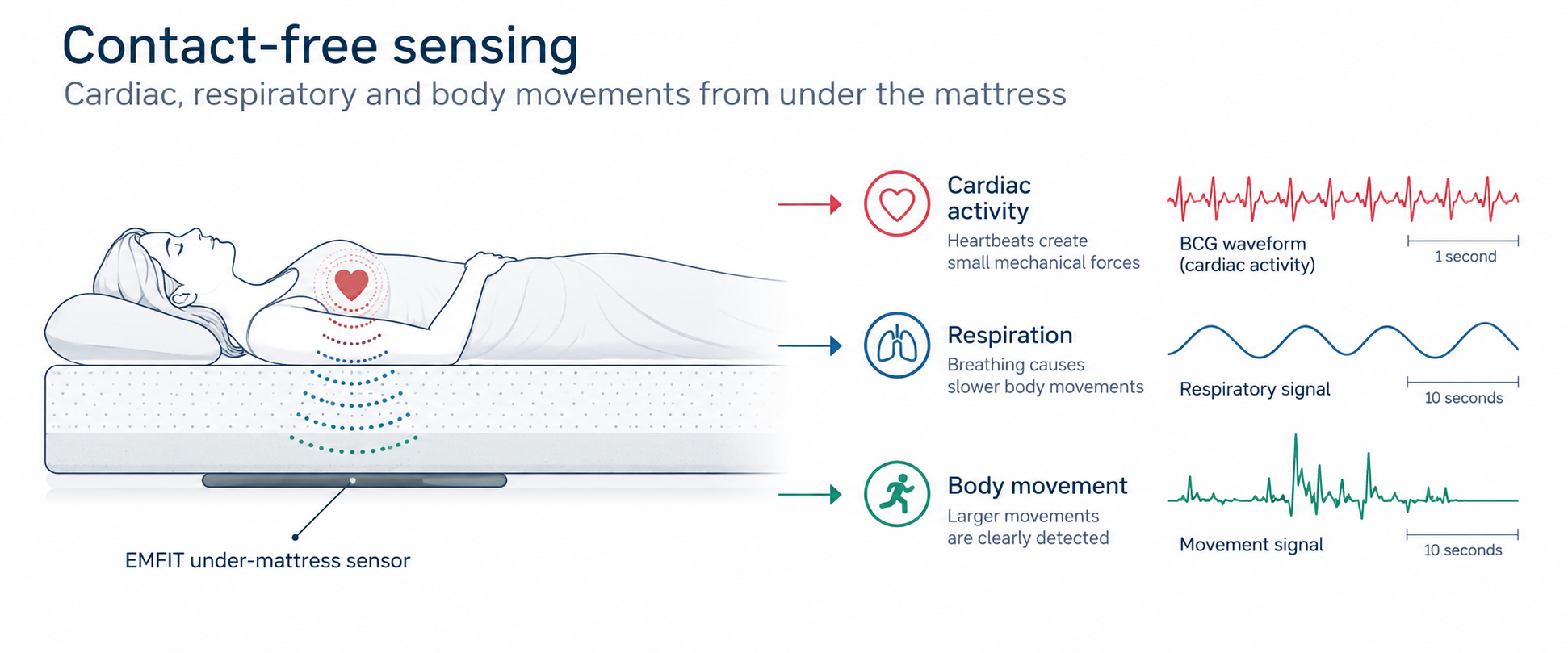
During sleep, an under-mattress sensor also detects mechanical signals caused by respiration, changes in body position and other body movements. Signal processing can be used to separate and analyse different components of the recorded signal.
This makes under-mattress sensing particularly well suited to unobtrusive physiological monitoring during sleep.
What can be detected from under the mattress?
A person lying in bed continuously produces mechanical signals at several different time scales.
Cardiac activity
The mechanical activity associated with individual heartbeats produces a repeating BCG waveform. Analysis of this signal can provide beat-to-beat timing information and parameters such as heart rate and heart rate variability (HRV).
Respiration
Breathing produces slower mechanical movements of the body that can also be detected through the mattress. These signals can be used to estimate respiratory rate and analyse breathing-related patterns.
Body movement
Larger body movements produce clearly distinguishable changes in the recorded signal. These can provide information about movement activity, turning in bed and bed presence.
The same sensor can therefore capture several layers of physiological and movement information simultaneously.
BCG is not ECG
Ballistocardiography and electrocardiography measure different physiological phenomena.
An electrocardiogram (ECG) measures the electrical activity of the heart using electrodes attached to the body. Ballistocardiography (BCG) measures the mechanical effects of cardiovascular activity — the small forces and body movements produced as the heart pumps blood through the circulation.
BCG should therefore not be considered a contact-free ECG.
However, when individual cardiac cycles can be reliably identified from the BCG signal, their timing can be used to determine heart rate and beat-to-beat intervals. These intervals can also be analysed to derive heart rate variability (HRV).
ECG and BCG are therefore fundamentally different measurement methods, although both can provide information about cardiac timing.
How EMFIT measures BCG
A sensitive sensor designed for mechanical signals
At the core of EMFIT’s under-mattress measurement technology is our proprietary electroactive film sensor.
The sensor material is permanently charged and self-biased. The sensing element itself is passive: mechanical deformation of the sensor generates an electrical signal without requiring an excitation voltage.
Its sensitivity, flexibility and large sensing area make the technology particularly well suited to detecting very small mechanical signals through a mattress.
The sensor responds to mechanical forces generated by cardiac activity, respiration and body movement. Electronics connected to the sensing element amplify and digitize the signal for further processing and analysis.
EMFIT sensor technology is developed and manufactured by Emfit in Finland.
From mechanical signals to physiological information
The signal recorded under a mattress contains several overlapping components.
Cardiac activity occurs at a relatively fast time scale. Respiration produces slower variations, while turning and other body movements create larger transient signals.
EMFIT signal-processing algorithms analyse these different components and derive physiological and sleep-related information from the recorded signal.
Depending on the product and application, this can include:
- heart rate
- beat-to-beat intervals
- heart rate variability (HRV)
- respiratory rate
- body movement and restlessness
- bed presence
- sleep and wake
- sleep-related parameters
For research applications, access to the underlying BCG waveform allows researchers to perform their own signal analysis in addition to using processed parameters provided by EMFIT.
Why measure from under the mattress?
Measurement without a wearable
One of the principal advantages of under-mattress sensing is that measurement requires very little interaction from the person being monitored.
There is nothing to attach to the skin and nothing that needs to be worn during sleep. Once the sensor has been installed, data collection can take place automatically whenever the person is in bed.
This makes the technology particularly suitable for repeated measurements over extended periods, where requiring the user to wear or actively operate a measurement device could affect data continuity.
Longitudinal measurement
Physiology and sleep vary considerably between individuals and also from one night to another. Long-term measurement makes it possible to observe an individual’s normal range and how physiological and sleep-related parameters change over time.
Because an under-mattress sensor can collect data automatically night after night, it is particularly well suited to longitudinal data collection over weeks, months or even years.
This is valuable in sleep and recovery research and in studies investigating physiological changes over extended periods.
Decades of development in bed-based sensing
Emfit has been developing electromechanical film sensors and bed-based sensing technology since the early 1990s.
Our first scientific publication involving EMFIT sensors dates back to 1993. In 1996, we began developing complete sensing systems, including applications for elderly care, and in 2004 introduced our first-generation contact-free vital signs monitor.
Since then, our bed-based sensing technology has evolved through multiple generations of sensors, electronics, signal acquisition and signal-processing algorithms.
This long development history has given us experience not only in detecting very small mechanical signals through a mattress, but also in collecting physiological data reliably and automatically over extended periods in real-world environments.
Today, the same core sensing principle supports applications in sleep monitoring, scientific research, elderly care and OEM integrations.
Used in scientific research worldwide
More than 100 scientific and clinical publications
EMFIT sensor technology has been used in scientific research since the early 1990s. Today, more than 100 scientific and clinical publications have used or investigated EMFIT sensor technology.
Research has covered a broad range of topics, including ballistocardiography, heart rate and heart rate variability, respiration, sleep, movement monitoring and long-term physiological measurement.
EMFIT technology has been used by universities, hospitals and research organizations in studies ranging from signal-processing research to clinical and long-term monitoring applications.